


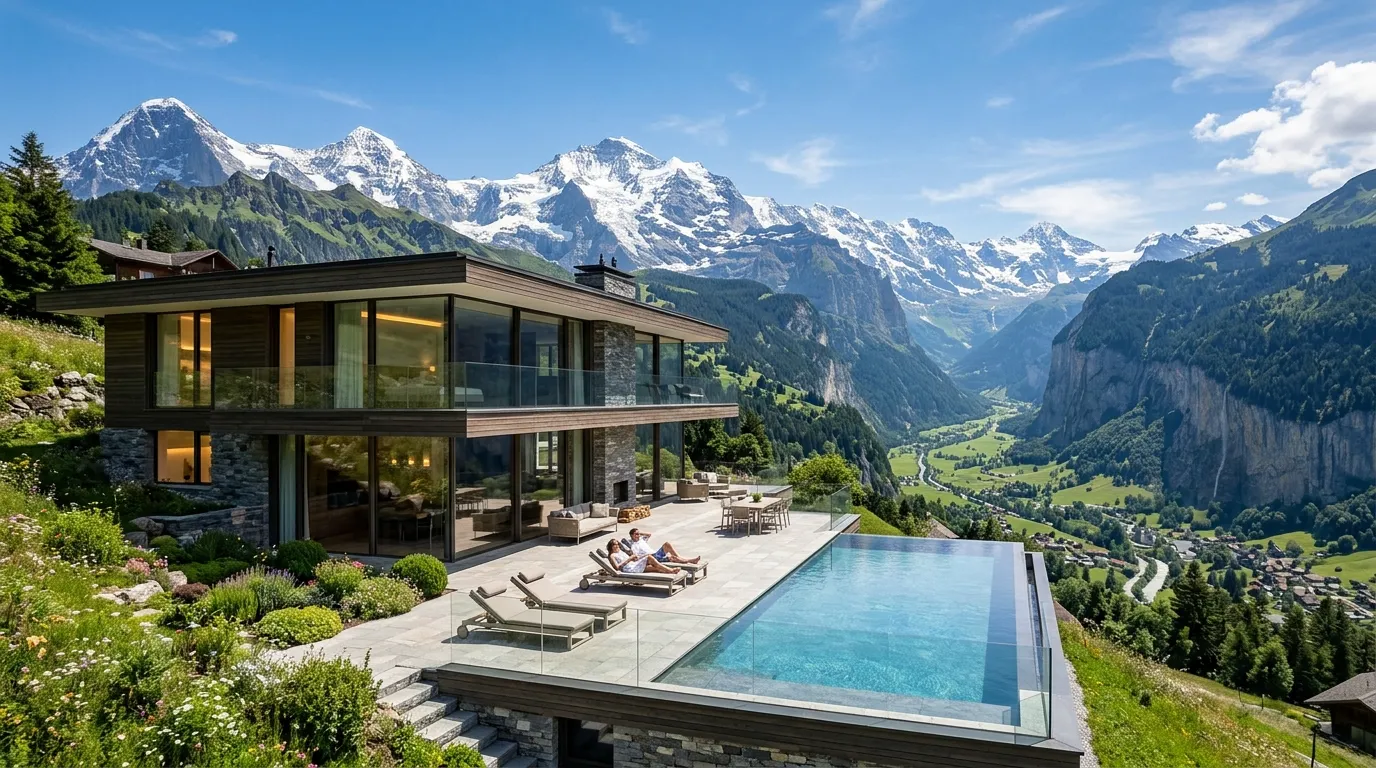
Snow-dusted Alpine chalets, lakeside villas, and prime city penthouses define one of the world’s most coveted property markets. Luxury real estate in Switzerland blends breathtaking scenery with unmatched stability, drawing affluent buyers worldwide. This guide unpacks prices, top locations, legal rules, and smart investment strategies to help you buy with confidence.
This guide covers everything you need to know about buying premium Swiss property. You’ll discover current market values, the most expensive locations and their price per square meter, the Lex Koller rules for foreign buyers, key regional markets, investment trends, common mistakes, and expert tips. By the end, you’ll understand exactly how to approach this exclusive, resilient market.
Why Switzerland Leads the Global Luxury Property Market
Few countries command the prestige that Swiss property enjoys. Political stability, a rock-solid economy, and the famously strong Swiss franc combine to make the country a safe haven for wealth. When global markets wobble, affluent buyers consistently turn toward Switzerland as a place to preserve and grow capital, and that demand keeps the premium segment remarkably resilient.
The numbers tell a compelling story. According to IMARC Group, the Swiss luxury residential market reached USD 14,585.8 million in 2025 and is projected to hit USD 21,246.6 million by 2034, growing at a 4.05% compound annual rate. That steady trajectory reflects sustained appetite from high-net-worth individuals seeking both a lifestyle upgrade and a dependable store of value.
Beyond finances, the appeal runs deeper. Buyers gain access to world-class skiing, pristine lakes, first-rate healthcare, top international schools, and enviable privacy. A home here isn’t just an address; it’s a passport to a certain quality of life. That blend of tangible lifestyle benefits and long-term security is precisely why luxury real estate in Switzerland continues to outperform expectations year after year, cementing its status among the elite.
Understanding Current Prices and Market Performance
Knowing what you’ll actually pay is the starting point for any serious buyer. The market moves at a measured pace, favoring gradual appreciation over volatile swings, which suits investors who value predictability. Recent data from UBS reveals both the scale of prices and the interesting regional dynamics shaping where value is concentrated.
In 2025, luxury prices across the 31 top Swiss locations analyzed in the UBS Luxury Property Focus 2026 rose by more than 3% on average. That represents a slight slowdown from the previous year and trailed the broader owner-occupied market marginally. The real standout, however, was the mountains, where prices climbed a striking 6%, outpacing the prior year and driven largely by affluent international buyers.
This divergence matters for your strategy. Urban and lakeside markets are maturing into steadier, more moderate growth, while Alpine destinations are surging. Mountain properties now cost roughly 40% more than they did five years ago, the strongest gain of any Swiss region. Increasingly, a chalet is viewed not merely as a holiday retreat but as a genuine investment asset, and experts see no near-term reversal in that upward trend.
Top Luxury Locations and Price Comparison
Location drives everything in this market, and Switzerland offers a remarkable spread of prestigious addresses. From glamorous ski resorts to serene lakeside enclaves, each commands its own premium. Understanding how these prime spots compare on price per square meter helps you benchmark value and target the right area for your goals and budget.
Three of the most expensive destinations are mountain resorts, led by St. Moritz. Remarkably, St. Moritz doesn’t just top the Swiss list; supported by the strong franc, it ranks first globally at more than USD 66,000 per square meter, ahead of both Monaco and Aspen. In the best micro-locations, six-figure prices per square meter are no longer unusual, underscoring the rarefied air of this segment.
The table below breaks down average asking prices across Switzerland’s most coveted luxury locations, giving you a clear side-by-side view.
|
Location |
Region |
Avg. Price (CHF/sqm) |
Character |
|---|---|---|---|
|
St. Moritz |
Mountains |
~52,000 |
World’s most expensive; glamorous Alpine resort |
|
Gstaad |
Mountains |
~45,000 |
Discreet, exclusive ski destination |
|
Verbier |
Mountains |
~45,000 |
Premier skiing and vibrant scene |
|
Cologny |
Lake Geneva |
~43,000 |
Prestigious lakeside residential enclave |
|
Küsnacht |
Lake Zurich |
~37,000 |
Most expensive spot on Lake Zurich |
These figures reflect averages, so exceptional properties with prime frontage, views, or architecture can command far more. Still, the ranking reveals a clear pattern: Alpine exclusivity now rivals and often exceeds traditional lakeside prestige. Whether you prioritize mountain glamour or lakeside calm, knowing these benchmarks equips you to negotiate from a position of genuine knowledge.
Exploring Switzerland’s Key Regional Markets
Switzerland’s luxury landscape is far from uniform. Each region carries its own economic drivers, buyer profiles, and momentum, so smart buyers match their choice to the local dynamics rather than treating the country as one monolithic market. Here’s how the major areas stack up according to recent UBS analysis.
Lake Zurich and Zug
This area draws demand chiefly from high-income expats attracted by strong employment and low taxes. In 2025, softer job growth around Zurich dampened demand somewhat, and asking prices came under sharper scrutiny in the transaction market. Zug, however, retained its momentum. Given the softer economic backdrop, willingness to pay for the most premium properties here is likely to plateau in the near term.
Lake Geneva
The Lake Geneva market is intensely international and has posted solid, if below-average, price growth in recent years. A key engine is the success of commodity trading firms, which strengthens buyers’ willingness to pay. UBS economists anticipate that gently rising demand from Middle Eastern buyers will generate renewed upward pressure on prices in this glamorous, French-speaking corner of the country.
Ticino and the Mountains
In Italian-speaking Ticino, prices largely stagnated, and selling periods run long, so sellers under time pressure often face discounts. Yet affluent arrivals from Italy and Lugano’s financial strength prevent broader declines. The mountains, meanwhile, remain the growth star, shaped by foreign investors with low price sensitivity who increasingly treat chalets as appreciating assets.
Navigating Lex Koller: Rules for Foreign Buyers
Here’s where many international buyers stumble, so pay close attention. Switzerland tightly regulates foreign property ownership through the Federal Act on the Acquisition of Immovable Property by Foreign Non-Residents, universally known as Lex Koller. Understanding it early saves you time, money, and considerable frustration during your search.
The core principle is straightforward: foreign non-residents generally need authorization from the relevant cantonal authority before buying. As the Swiss Federal Office of Justice explains, enforcement falls to the canton where the property sits, and whether a transaction needs approval depends on the specifics of each case. Authorization is granted only on grounds set out in the law.
Your nationality and residence status change everything. According to ch.ch, the rules break down roughly like this:
- EU/EFTA nationals living in Switzerland: Same rights as Swiss citizens; no permit needed.
- C permit holders: Also enjoy the same rights as Swiss citizens.
- Non-EU/EFTA residents: Need authorization for holiday homes and second homes, but not for a main residence they’ll actually live in.
- Foreign nationals living abroad: Generally require authorization to buy at all.
There are further constraints worth knowing. A national quota caps holiday-home sales to foreigners at roughly 1,500 units per year, and some cantons, including Geneva and Zurich, prohibit such sales entirely. Holiday-home living areas are typically capped at 200 square meters. Crucially, owning property does not grant you a residence permit, a common misconception that trips up newcomers. Always confirm your situation with the specific canton before committing.
What’s Driving Demand: Key Investment Trends
Understanding the forces shaping the market helps you invest wisely rather than reactively. Several powerful trends are converging to sustain and reshape demand for premium Swiss homes, and aligning your purchase with them can enhance both enjoyment and long-term value. These shifts reflect evolving buyer priorities across the wealthy global elite.
The dominant driver remains the flight of high-net-worth individuals toward stability and privacy. Buyers from regions facing political or economic uncertainty view Switzerland as a secure harbor, prizing its strong legal system, discreet banking environment, and favorable tax arrangements. This safe-haven appeal intensifies whenever global conditions grow turbulent, keeping a steady stream of international capital flowing into prime properties.
Two further trends are transforming what luxury actually looks like. First, sustainability has moved from nice-to-have to essential. Affluent buyers increasingly demand eco-friendly features such as geothermal heating, solar panels, advanced insulation, and green spaces, pushing developers to build homes that align with environmental values. Second, technology integration is now expected, with smart-home systems for lighting, climate, security, and entertainment, plus IoT connectivity that links everything seamlessly. Younger wealthy buyers in particular treat these high-tech, energy-efficient features as baseline requirements rather than optional extras, reshaping new developments across the country.
The Buying Process: A Step-by-Step Overview
Purchasing at this level rewards preparation and the right team. While every transaction has its quirks, following a logical sequence keeps you organized and reduces risk. Think of the process as a series of deliberate steps rather than a single leap, and you’ll navigate it far more smoothly from search to signature.
Start by clarifying your eligibility under Lex Koller, since this determines what you can even buy. Next, engage local experts early: a specialist real estate agent, a Swiss notary, and ideally a lawyer familiar with cross-border purchases. Their guidance is invaluable given the cantonal variations in rules, taxes, and procedures that outsiders rarely anticipate on their own.
From there, the practical journey typically unfolds in stages:
- Define your criteria: Pin down location, property type, budget, and must-have features.
- Secure financing: Arrange mortgage pre-approval or confirm funds, factoring in the strong franc.
- View and shortlist: Visit properties, ideally in person, to assess condition and setting.
- Make an offer and check permits: Negotiate terms and verify any required authorization.
- Notarize and register: Sign the deed before a notary and register the transfer.
Patience pays throughout, especially in slower markets like Ticino where selling periods stretch long. Rushing invites costly errors, while a measured, well-advised approach protects your interests. Treat each step as a checkpoint, confirm everything in writing, and lean on your professional team whenever uncertainty arises.
Common Mistakes to Avoid
Even sophisticated buyers make avoidable errors in this specialized market. Recognizing these pitfalls in advance protects both your finances and your peace of mind. Steer clear of the following missteps and your purchase will proceed with far less friction and far fewer unwelcome surprises.
First, don’t ignore Lex Koller until late in the process. Assuming you can freely buy any property is a costly miscalculation, since foreign non-residents often need cantonal authorization and some cantons ban certain sales outright. Confirm your eligibility before you fall in love with a home you legally cannot purchase.
Second, avoid the persistent myth that buying property grants residency. It does not. If your goal includes living in Switzerland, you must pursue immigration channels separately through the relevant authorities. Conflating the two leads to serious disappointment and derailed plans.
Third, don’t overlook regional dynamics. Buying in a stagnant market like Ticino under time pressure can force painful discounts, while overpaying in a cooling urban market erodes value. Study local momentum first. Finally, resist skipping local professional advice. Cantonal differences in tax, procedure, and quotas are genuinely complex, and a knowledgeable notary or lawyer easily pays for themselves by preventing expensive mistakes.
Pro Tips and Expert Insights
A handful of insider strategies can meaningfully improve your outcome in the premium Swiss market. These reflect how seasoned investors and advisors actually approach high-value purchases, and applying them puts you a step ahead of less-prepared buyers competing for the same rarefied properties.
Follow the mountain momentum thoughtfully. With Alpine prices up roughly 40% over five years and still climbing, resorts like St. Moritz, Gstaad, and Verbier increasingly function as investment assets, not just retreats. If appreciation matters to you, weight your search toward these resilient, foreign-driven markets, but buy quality micro-locations rather than chasing the average.
Leverage the strong franc strategically. The currency’s strength underpins Swiss prices globally and reinforces the country’s safe-haven status. For buyers holding francs or hedging appropriately, this stability protects long-term value, though foreign-currency buyers should plan carefully around exchange-rate exposure before committing large sums.
Prioritize sustainable, smart-equipped homes. Properties with geothermal heating, solar power, strong insulation, and integrated smart-home technology increasingly command premiums and attract the next generation of wealthy buyers. Choosing such a home now positions you well for future resale demand.
Engage canton-specific expertise. Because rules, taxes, and quotas vary so widely between cantons, a local advisor who knows your target area intimately is worth every franc. Their nuanced knowledge routinely uncovers both opportunities and hidden obstacles.
Conclusion
Luxury real estate in Switzerland offers a rare blend of stunning lifestyle, enduring stability, and steady appreciation, from record-setting St. Moritz chalets to prestigious lakeside villas. Success comes down to understanding prices, mastering Lex Koller, and choosing the right region with expert guidance. Ready to explore your dream Swiss property? Connect with a specialist advisor today and start your search with confidence.
Frequently Asked Questions
1. How much does luxury real estate in Switzerland cost?
Prices vary dramatically by location. St. Moritz leads at around CHF 52,000 per square meter, followed by Gstaad and Verbier near CHF 45,000, Cologny on Lake Geneva at about CHF 43,000, and Küsnacht on Lake Zurich near CHF 37,000. In 2025, prices across the top 31 Swiss locations rose more than 3% on average, with mountain regions surging 6%. Exceptional properties can far exceed these averages.
2. Can foreigners buy property in Switzerland?
Yes, but rules depend on nationality and residence status under Lex Koller. EU/EFTA nationals living in Switzerland and C permit holders enjoy the same rights as Swiss citizens. Non-EU/EFTA residents need authorization for holiday and second homes, though not for a main residence. Foreign nationals living abroad generally require cantonal authorization to buy at all. Always confirm your specific situation with the relevant canton first.
3. What is Lex Koller?
Lex Koller is the popular name for the Federal Act on the Acquisition of Immovable Property by Foreign Non-Residents. It limits foreign ownership of Swiss property to prevent excessive foreign control of Swiss territory. The law generally requires foreign non-residents to obtain authorization from the canton where the property is located. Enforcement and interpretation vary by canton, so professional local advice is strongly recommended before purchasing.
4. Does buying property in Switzerland grant residency?
No. This is a common and costly misconception. Owning property in Switzerland does not entitle you to a residence permit. If you wish to live in the country, you must pursue immigration separately through the State Secretariat for Migration or your canton’s immigration authorities. Property ownership and residency are entirely distinct legal matters, so plan each independently if you intend to both buy and relocate.
5. Which is the most expensive luxury location in Switzerland?
St. Moritz is the most expensive location, with average prices around CHF 52,000 per square meter. Remarkably, supported by the strong Swiss franc, St. Moritz also ranks as the most expensive luxury market in the world at more than USD 66,000 per square meter, ahead of Monaco and Aspen. In its best micro-locations, six-figure prices per square meter are increasingly common.
6. Is Swiss luxury property a good investment?
For many buyers, yes. The market offers stability, steady appreciation, and safe-haven appeal backed by a strong economy and currency. IMARC projects growth from USD 14,585.8 million in 2025 to USD 21,246.6 million by 2034. Mountain properties have gained around 40% over five years and are increasingly viewed as investment assets. As with any purchase, location, timing, and professional guidance strongly influence returns.
7. Why are Swiss mountain properties rising in value so fast?
Alpine luxury homes have climbed roughly 40% over five years, the strongest growth of any Swiss region, with a 6% rise in 2025 alone. Demand is driven largely by foreign investors with low price sensitivity who increasingly treat chalets in St. Moritz, Gstaad, and Verbier as appreciating investment assets rather than mere holiday retreats. Experts expect no near-term reversal in this upward trend.
8. Are there restrictions on buying holiday homes in Switzerland?
Yes. A national quota limits holiday-home sales to foreign nationals to roughly 1,500 units per year, allocated among cantons. Some cantons, including Geneva and Zurich, prohibit such sales to foreigners entirely. Holiday homes for foreign buyers are typically capped at around 200 square meters of living area, must sit in tourist areas, and cannot be rented out year-round. Rules vary, so check locally.
9. What trends are shaping the Swiss luxury property market?
Three trends dominate. First, high-net-worth individuals continue seeking stability and privacy, especially from politically or economically uncertain regions. Second, sustainability now drives demand, with buyers wanting geothermal heating, solar panels, and energy efficiency. Third, smart-home technology and IoT integration have become expected features, particularly among younger affluent buyers. Together these forces reshape both what buyers want and how developers build premium homes.
10. Do I need a lawyer to buy luxury property in Switzerland?
While not always legally mandatory, engaging local experts is highly advisable. A Swiss notary handles the deed and registration, but a specialist real estate agent and a lawyer familiar with cross-border purchases and Lex Koller are invaluable. Cantonal differences in rules, taxes, and quotas are genuinely complex, and professional guidance prevents costly errors while ensuring your transaction complies fully with all applicable requirements.
